6 Free Ways to Find Expired Domains
You can hunt expired domains without spending anything on tools; thousands of people do it every day. What free hunting costs instead is time and shared visibility, because anything a free source shows you, it shows everyone. This list ranks the six genuinely free methods by results per hour, tells you what each one is actually good at, and finishes with honest math about the point where free stops being cheap. If you want the full landscape including paid routes, our ranked guide to all nine ways to find expired domains is the bigger map.
The six methods compared
| # | Method | Real cost | Time per session | Competition on finds |
|---|---|---|---|---|
| 1 | ExpiredDomains.net | $0; registration unlocks filters | 30-60 minutes daily | High |
| 2 | Free lookup and finder tools | $0 | Minutes | High |
| 3 | Registrar auction and closeout browsing | $0 to browse; GoDaddy membership about $5/yr | About 30 minutes | High |
| 4 | Wikipedia dead-link mining | $0 | Hours | Low |
| 5 | Google operators for dead projects | $0 | Hours | Low |
| 6 | CZDS zone-file diffs | $0 plus scripting time | Heavy setup, then automated | Very low |
1. ExpiredDomains.net: the free standard
The obvious first stop, and rightly so. ExpiredDomains.net tracks domains across 676 TLDs, updates daily, and costs nothing; free registration unlocks the filter set, which is where the tool becomes usable, letting you cut lists by length, keyword, TLD, backlink counts and dozens of other columns. Its limitation is the same as its strength: it is the default, so every obvious gem on this morning's list has already been seen by thousands of other hunters. Use it to learn what the market looks like, to build filter instincts, and to catch the names good enough for you but not obvious enough for everyone.
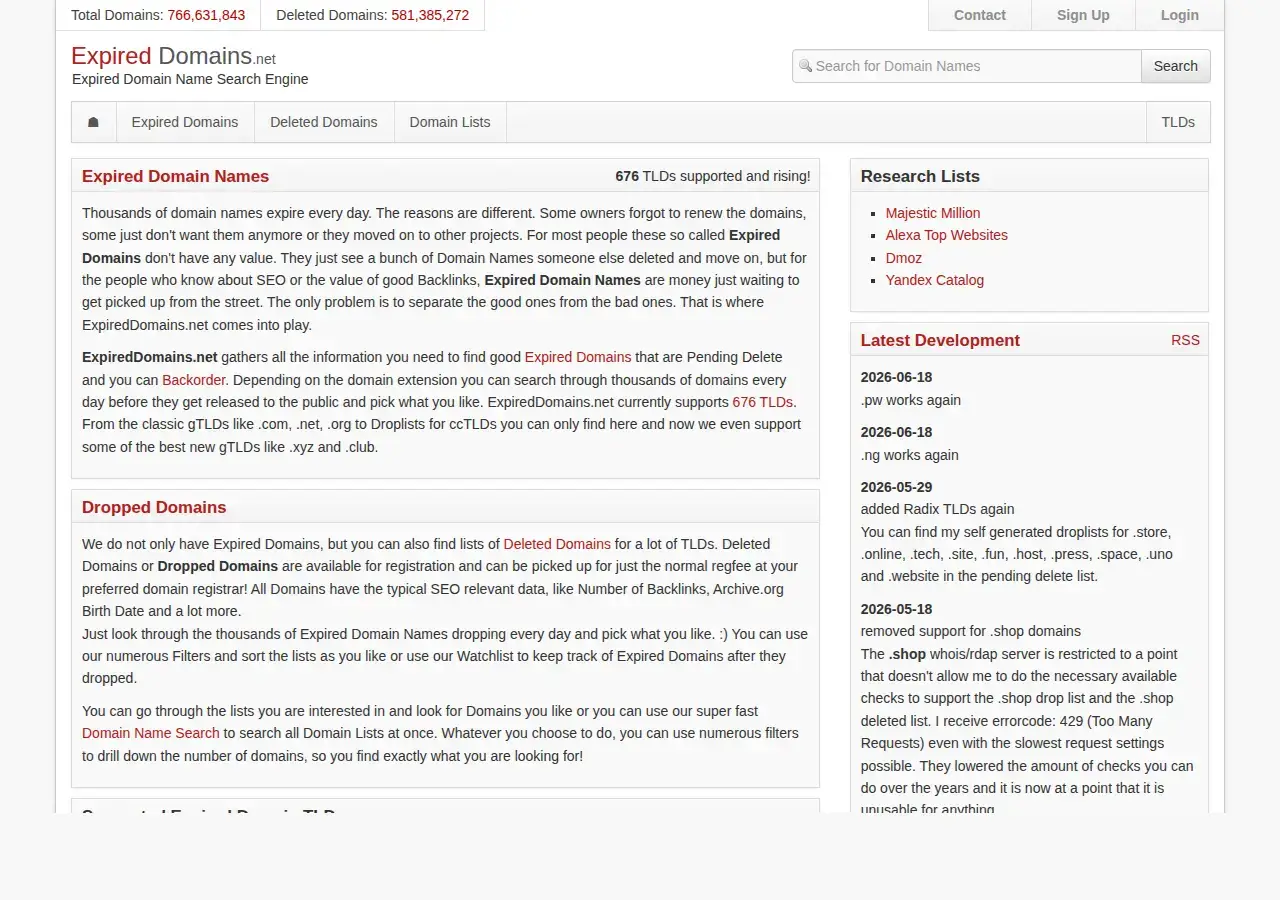
The ExpiredDomains.net homepage, captured August 2026
2. Free lookup and finder tools
A layer of free web tools surfaces expired and expiring names with zero setup: Instant Domain Search runs a free expired domains view, and the free tier of the desktop app Domain Hunter Gatherer handles marketplace hunting, which we covered in our full 2026 review. These are shallow compared to a filtered database, but they cost minutes rather than sessions, and they suit name-first hunters checking whether anything decent matches a keyword today.
3. Registrar auction and closeout browsing
Registrars run their own expiry streams, and browsing them is free window-shopping with real bargains at the bottom. GoDaddy Auctions adds 35,000+ new expiring domains daily behind a membership of roughly $5 per year, with closeouts starting near $5 for names nobody bid on. Dynadot runs a closeout ladder that steps unsold expiring names down through roughly $30, $15 and $5, with a $5 account minimum to participate. Namecheap Market runs daily auctions including, since February 2025, the official expiry stream for .ai domains. Discovery is free; buying obviously is not, but closeout prices sit below most people's coffee budgets, and expiry-auction wins keep the domain's original age.
4. Wikipedia dead-link mining
Wikipedia flags citations whose targets died, creating a public map of dying domains curated by editors. Search the flagged references in your topic, extract the cited domains, and check which have actually dropped; the survivors of vetting arrive with a live Wikipedia citation attached. It is slow, manual, entirely free and almost uncontested, and the full method, including the nofollow honesty and the rebuild ethics, is in our guide to mining Wikipedia's dead links.
5. Google operators for dead projects
Google itself is a free expired domain scanner if you ask it the right questions. Operator combinations like site: restricted searches on old directories, or intitle: and inurl: queries against resource pages and defunct project types in your niche, surface sites that stopped updating years ago; a WHOIS check then tells you which of their domains have lapsed or are heading that way. This is prospecting rather than harvesting: hours of clicking for a handful of leads, but leads nobody else has, because no two hunters run the same queries.
6. CZDS zone-file diffs: free data at industrial scale
The most technical entry. ICANN's Centralized Zone Data Service grants free access to daily zone files for most gTLDs; download today's zone, diff it against yesterday's, and every domain that vanished is a deletion candidate you discovered from primary data, hours before casual hunters see it packaged in a tool. The cost is engineering: applications per registry, storage for very large files, and scripts you maintain yourself. For programmers, this is the most independent pipeline available; for everyone else, it is the clearest illustration of what paid tools are actually charging for.
A free weekly routine that combines them
The methods stack naturally into a schedule that costs zero dollars and a few disciplined hours. Run a filtered ExpiredDomains.net session most mornings and keep a shortlist file. Sweep registrar closeouts twice a week, since the ladder prices reward whoever checks after the crowd loses interest. Reserve one longer block weekly for the slow, uncontested methods: Wikipedia mining or operator prospecting in your niche. Vet everything the same way regardless of source: Wayback history, anchor sanity, and a site: check before any registration. A month of that routine teaches more about domain quality than any tool trial, and it leaves you knowing exactly which step deserves automation first.
The honest math: when free stops being cheap
Free methods produce real finds, and every serious hunter should learn on them. But tally the hours honestly: a daily ExpiredDomains.net session, manual vetting for every candidate, spreadsheet upkeep, and the misses when contested names needed faster data. When those hours start mattering, the first paid upgrade most hunters consider is an aggregator; DomCop bundles the drop, auction and deleted streams with Majestic and Moz filtering from roughly $68 per month on annual billing, with no free trial and a 2-day money-back guarantee as the escape hatch. Spam-focused pre-filtering from SpamZilla (from $37 per month) is a narrower, cheaper add-on that sits below a full aggregator rather than replacing one. The right time to pay is when your hours are worth more than the fee, and not before.
Frequently asked questions
Is there a completely free expired domains list?
Yes. ExpiredDomains.net publishes free daily lists across 676 TLDs, and free registration unlocks its filters. Registrar closeout and auction sections are also free to browse, and zone-file diffs give technical users free primary data.
Can I find expired .ai or .io domains free?
You can discover them free, but acquisition differs. Expired .ai names never free-drop; they route through official daily auctions run via Namecheap since February 2025. Many .io names do drop conventionally, though contested ones get chased by paid catching services.
Do paid tools offer free trials?
Mostly no in this market. DomCop has no free trial and relies on a 2-day money-back guarantee; SpamZilla starts at $37 per month. Treat the free methods in this list as your trial period: they teach the same filtering instincts.
Are free methods good enough for SEO-grade domains?
Yes, with patience. The domains are the same; paid tools change how fast you see them and how much vetting data arrives attached. Free hunters compete at a time disadvantage, which matters most on obvious, contested names and least on niche finds.